Change the system once. Keep every brand.
I made shared catalog changes carry across applicable programs, without touching the legacy variables that kept live program sites stable.
Owner of design and shared styles: page layouts, the design system, and the inheritance model.
Catalog layout and style inheritance across applicable programs.
- SCSS
- brand.scss
- Smoke environment
- Cypress
- Playwright
The 30-second version
For busy reviewersThe problem
Catalog styles didn’t inherit the surrounding program’s template styles, so one shared improvement became a series of program-by-program CSS edits, and drift crept in between contributors.
What I did
I kept legacy variables untouched, wrote shared styles for common presentation, and gave each program’s fonts and hero an explicit home in brand.scss. I also flagged two release risks the plan had missed.
The result
In production in 2025. Shared adjustments now reach applicable programs without editing each page, and brand choices stay where they belong.
One catalog improvement, many separate jobs
Why a common design decision kept turning into manual work.
V6 catalog styles didn’t automatically inherit the program’s template styles, so each program needed manual alignment. Code from multiple contributors expressed similar elements in different ways, which created inconsistencies with the design system and visual regressions.
My goal was to give shared presentation a common foundation, and give program-specific branding an explicit place within it.
- Shared changes applied program by program
- Similar elements coded differently by different people
- Regressions found late, page by page
- Don’t change existing variables: it could break live styling
- Programs with custom XSL need a release cycle
- Recently migrated V5 programs must not be missed
Extend the system without changing legacy variables
Three layers, each with one job.
We were told not to change existing variables, because that could break styling or cause regressions. I designed the page layouts and design system, kept those variables intact and wrote shared styles for common presentation.
I extended the system with brand-specific variables, and defined program-specific hero treatments and font pairings in brand.scss. One program might need a form in its hero, another CTA buttons, another a different arrangement of text.
Existing values stay as they are, so current programs can’t regress.
Buttons, type scale, catalog layout. Change once, reach every applicable program.
Font pairings, hero treatment, brand-specific variables.
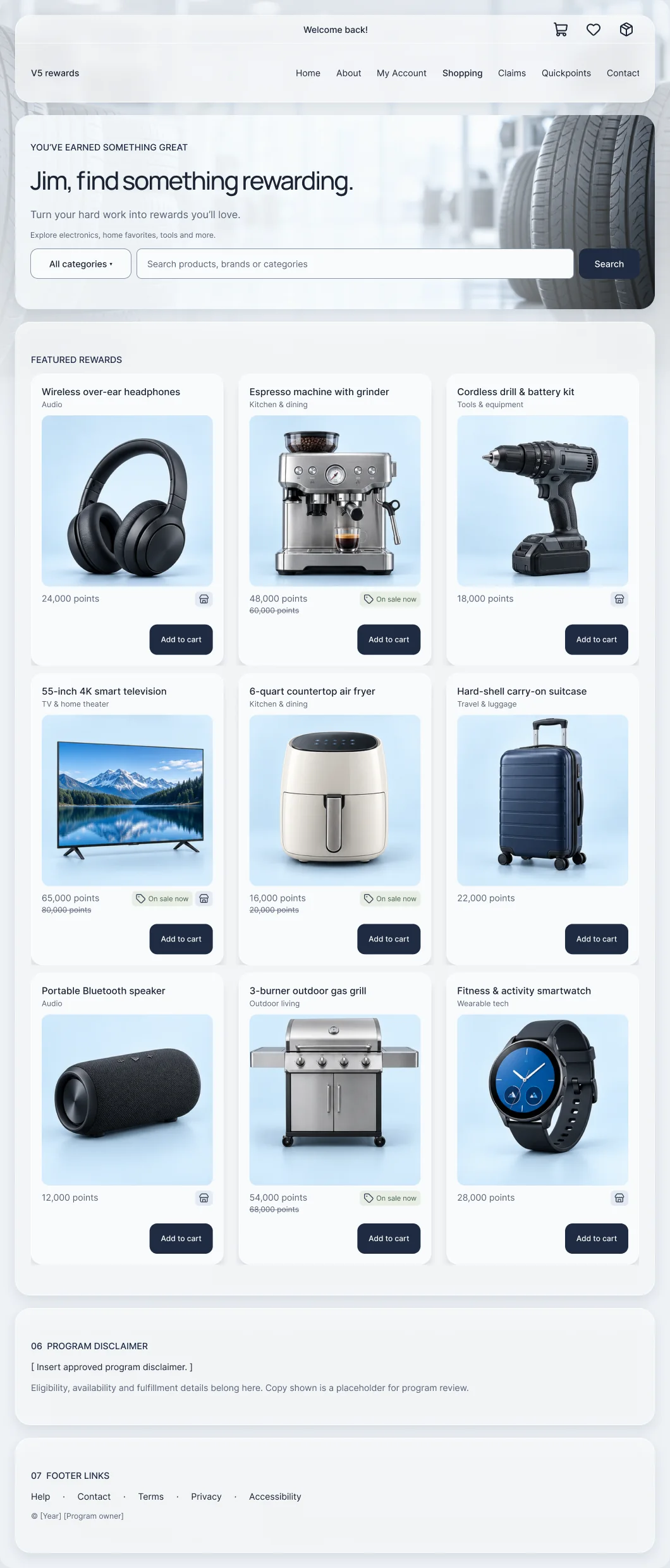
See one shared update travel
Buttons and type were the practical test of the inheritance model.
Before: each program’s button was adjusted by hand.
Raise the release risks before they ship
Two considerations I flagged in pre-planning. The project lead added both to the feature.
Custom XSL programs
A style change also depends on custom XSL work and a scheduled release.
Handling: treated as a release dependency, not an exclusion, and added to scope.
Recently migrated V5 programs
A program that just finished its V5 upgrade could be missed by the V6 initiative.
Handling: explicitly included in the feature.
- Plan
Scope applicable programs and release dependencies.
- Shared layer
Common presentation in shared styles.
- Brand layer
Fonts and hero treatments in brand.scss.
- Validate
Smoke-environment comparisons plus Cypress and Playwright regression checks.
- Release
Production batches, highest-revenue accounts first.
Make future changes centrally
What’s confirmed, and what isn’t claimed.
I used AI-assisted JavaScript authoring to contribute Cypress and Playwright regression tests alongside smoke-environment comparisons. No final-state production screenshots were recovered, so the visuals on this page are labeled explanations, and I don’t turn eligible-program counts or planned test coverage into results.
What else was on the table
Schematic comparisons. Retrospective alternatives are not confirmed historical rejections.
Change existing variables
Rewrite global variable values to force catalog consistency.
Ruled out by the stated constraint: it could break styling and cause regressions.
Independent program styles
Keep each program’s catalog styling separate and align it page by page.
The starting condition. It repeats work and lets contributors drift apart.
Switch to Deep for the alternatives.